The same white walls and peeling blue chairs. The same speculations and prayers. The same crowd shifting nrevously in their seats. The same delays. The same excuses.
Well, pretty much. Today, after over an hour delay, a summary of half the evidence presented by the prosecution was read. All 3 judges were there this time; one was apparently ill (though I couldn't tell which one--maybe the one that sniffled a couple of times?) and so, of course, the trial was postponed until Monday.
This time, it was clear that everyone had had enough, and the frustrations of both family members and the defendents was more than evident.
My predictions for Monday's session? If we are lucky, they might get through the rest of the evidence. But then it will probably be adjourned again before any ruling is given.
Friday, March 30

Thursday, March 29
Sachs is Back in Town
It seems that economist-turned-celebrity Jeffrey Sachs will be in town on Monday for the upcoming ECA conference. The topic is “Investment in Africa”, and all of the continent’s Ministers of Finance are invited. Sounds like quite the party.
I wonder if we can look forward to surrendering the city to blue-camoflauged federal security forces once again?
I wonder if we can look forward to surrendering the city to blue-camoflauged federal security forces once again?
Tuesday, March 27
Blocked Again
I am unable to access blogspot once again.
Maybe it is just a glitch? Otherwise, back to the same old...
(It was nice while it lasted!)
Maybe it is just a glitch? Otherwise, back to the same old...
(It was nice while it lasted!)
Monday, March 26
Hope

After the disappointment of Friday’s session, I chastised myself for getting my hopes up. But today I have decided otherwise.
Instead, I choose to hope even more ferverently that they will be released at the end of this week. In the days to come., I will envision the happy reunions and city-wide celebrations, and will dwell on the thought that the agony of our friends and heros will soon be over.
I will choose to hope, simply because I can.
Instead, I choose to hope even more ferverently that they will be released at the end of this week. In the days to come., I will envision the happy reunions and city-wide celebrations, and will dwell on the thought that the agony of our friends and heros will soon be over.
I will choose to hope, simply because I can.
Even the EPRDF cannot take that away.
Sunday, March 25
Blogging on ethio-zagol post
I will now be contributing from time to time on seminawork blog and am happy to be invited to participate in his/her newly established community forum. See my first post here.
The new format of this site is really exciting--breaking news, blogs, diaries--the perfect arena for thoughtful public debate and productive dialogue. Exactly the kind of thing we need around here these days. EZ has done it again!
(I will still continue blogging regularly on this blog.)
The new format of this site is really exciting--breaking news, blogs, diaries--the perfect arena for thoughtful public debate and productive dialogue. Exactly the kind of thing we need around here these days. EZ has done it again!
(I will still continue blogging regularly on this blog.)
Friday, March 23
Trial Update
It was a beautiful morning and we all arrived early in order to get a seat, as it was rumored that they would only be allowing a limited number of people inside the courtroom today.
There was an unusual feeling of excitement in the air, and even the most skeptical among us dared hope that today was THE day. All the regulars were there—the ferenj (journalists , observers, and diplomats) crowding the front rows, the immediate family members behind to the left, and additional relatives, friends and supporters left to fill in the gaps.
As usual, we had time to kill. After the greetings, speculations and words of encouragement were exchanged, casual conversation began to wane and the defendants had still not appeared.
Finally, shortly after 10 o’clock, they were brought in and everyone sprang to their feet, waving and smiling (now skilled in the art of communicating without words.) The prisoners looked well and flashed us triumphant thumbs-up as they filed in. They appeared overjoyed to see one another again, and we silently interpreted this scene as the appropriate prelude to their immediate release.
After about 15 minutes everyone was settled in their seats and the judges filed in.
Leul. Momhammed…When it was clear that Judge Adil would not be present (a fact that was neither acknowledged nor recorded), all hope instantly evaporated.
The session was over less than 5 minutes later.
The trial would once again be adjourned, due to the “complexity of the case”, we were told. At first, the date of May 9th was given, which was almost immediately corrected to April 9th. By way of excuse, the judge assured us that they had first intended to resume proceedings on March 30th, but couldn’t because it was a holiday. Then he hesitated again, and consulted the other, amidst disproving murmers from the crowd. After a few moments of confusion, he again corrected himself and announced that the trial would definitely resume the following Friday (the 30th). He announced that on this date the court would make their final ruling and then repeated that this would be the “last one”.
(It is amazing, really. He must have spoken less than 5 sentences--which he had over two weeks to prepare--and he still managed to get it wrong not once, but twice!)
There were sighs and tears from family members, and frustration was evident on the faces of all in attendance.
And then it was over.
There was an unusual feeling of excitement in the air, and even the most skeptical among us dared hope that today was THE day. All the regulars were there—the ferenj (journalists , observers, and diplomats) crowding the front rows, the immediate family members behind to the left, and additional relatives, friends and supporters left to fill in the gaps.
As usual, we had time to kill. After the greetings, speculations and words of encouragement were exchanged, casual conversation began to wane and the defendants had still not appeared.
Finally, shortly after 10 o’clock, they were brought in and everyone sprang to their feet, waving and smiling (now skilled in the art of communicating without words.) The prisoners looked well and flashed us triumphant thumbs-up as they filed in. They appeared overjoyed to see one another again, and we silently interpreted this scene as the appropriate prelude to their immediate release.
After about 15 minutes everyone was settled in their seats and the judges filed in.
Leul. Momhammed…When it was clear that Judge Adil would not be present (a fact that was neither acknowledged nor recorded), all hope instantly evaporated.
The session was over less than 5 minutes later.
The trial would once again be adjourned, due to the “complexity of the case”, we were told. At first, the date of May 9th was given, which was almost immediately corrected to April 9th. By way of excuse, the judge assured us that they had first intended to resume proceedings on March 30th, but couldn’t because it was a holiday. Then he hesitated again, and consulted the other, amidst disproving murmers from the crowd. After a few moments of confusion, he again corrected himself and announced that the trial would definitely resume the following Friday (the 30th). He announced that on this date the court would make their final ruling and then repeated that this would be the “last one”.
(It is amazing, really. He must have spoken less than 5 sentences--which he had over two weeks to prepare--and he still managed to get it wrong not once, but twice!)
There were sighs and tears from family members, and frustration was evident on the faces of all in attendance.
And then it was over.
Monday, March 19
The IMF: Friend or Foe?

<
On March 17th, the International Monetary Fund (IMF) released the 2007 Country Report for Ethiopia. The findings of this report include a national economic “growth rate of almost 11 percent” (from 2003/3004-2005/2006), which has resulted in a “real per capita income increasing at the fastest rate in Ethiopia’s recent history” at 7 percent per annum over the same 3-year period (translating to $121 annual per capita income, according to ATLAS calculations).
Frankly, this comes as quite a surprise to me. While I do not have enough information to confidently assess their methods of data collection, I can assure you that such growth has yet to trickle down into the pockets of the poor (or even the middle class, for that matter), though the current rate of inflation is noticeably felt by all.
For those not living in this country (or, rather, any of us who have more than $121/year on which to survive!) this new GDP figure, while perhaps a statistical improvement from a decade ago, is nearly impossible to grasp in actual terms. Let’s forget the math for a moment--a stroll through Shola market on a Saturday afternoon unfortunately proves a far more accurate indicator of current economic conditions than any official document. Considering a friend struggling to feed her family on a monthly income of 400 birr (approximately $50/month) puts things sharply into perspective for me: one litre of oil now sells for 16 birr. A kilo of tomatos 4 birr, onions 3.5; oranges, sugar and coffee (unroasted) have become rare luxuries, at 6, 8 and 24-26/kilo, respectively. A large loaf of bread sells for 2 birr and a month’s supply of teff flour (50 kilos for a small family of 5) has become unafforable at 250- 270 birr. 1.5 litres of bottled water sells for 4 birr and omo (washing powder) for around 24/kilo.
And it gets worse. The eucalyptus debate can be put on hold in Ethiopia it seems, as the price of charcoal has actually doubled (a month’s supply is now 80 birr); at 1 birr each, cow dung patties have become the biomass fuel of choice for the majority of poor households (and for the bargain of a single birr, the health hazards of methane gas must be necessarily forgotten).
Yet, in spite of these drastic increases, none can compete with the leap petrol has taken in recent months. From around 5 birr/litre in August, it has since been driven up to 8.25, and rising still. Cars have become weekend luxuries for former 7-day motorists, and taxi drivers are forced to continually count their losses (as people are increasingly unable to pay the higher fares). A mini-bus ride costs between 65 cents-$1.60 birr, while 50 cents now barely guarantees you standing room on the perilously crowded yellow city buses. In this light, feeding even a small family on $50/month becomes a super-human feat, yet this is nearly 5 times the average per capita income in Ethiopia today, according to the findings of the annual IMF country report.
Which brings us back to the role of this instituion in developing economies such as this one:
The IMF can certainly be recognized as more-highly functioning than the plethora of international aid agencies that currently saturate this region of the world, however, their credibility in the arena of the world’s poorest populations (and not Western or emerging markets, where they have achieved some success) must come from actual measured achievements and not merely relative success in comparison to the abysmal failures of the aid industry as a whole. After all, millions of lives are at stake.
Accordingly, when considering the recommendations of country reports such as this one, we would be well-served to begin with a single, basic question: Has the IMF actually proven its ability to achieve macroeconomic stability in the poorest regions of the world? (Unfortunately, I think we all know the answer to that one…)
Absolutely, these countries are plagued by severe obstacles to economic prosperity (the “root causes of extreme poverty”, --political, historical, geographical, social) for which the IMF cannot be blamed, but it is worth noting that (as pointed out by NYU professor of economics and former senior World Bank economist, William Easterly, in his fascinating book “White Man’s Burden”) “of all 8 cases worldwide of state-failure or collapse”--Afghanistan, Angola, Burundi, Liberia, Sierra Leone, Somalia, Sudan, Zaire—“seven of them had a high share of time under IMF programs in the 10 years preceeding their collapse”; therefore, “statistically speaking, spending a lot of time under an IMF program is associated with a higher risk of state collapse”. This seems as good a starting point as any and, at the very least, should raise some serious red flags regarding the credibility of such intervention methods within the Ethiopian context.
Though officially “the financial assistance provided by the IMF enables countries to rebuild their international reserves, stabilize their currencies and continue paying for imports” ( www.imf.org/external/np/exr/facts/howlend.htm), recent history sadly demonstrates that quite the opposite has been achieved. A great part of the problem lies in the fact that statistics available in the poorest countries of the world--the very same statistics used to determine the current GDP and thus predict future economic performance--are often unreliable or downright inaccurate (due to the challenges of gathering information from highly inaccessible rural regions combined with widespread political corruption and intentional data manipulation). Also, how do the “human complexities” that cannot be represented by a financial programming model accurately factor into such country projections and interventions? The problem is they cannot, and do not.
Further, the nasty habit of refusing to seriously penalize the fiscal corruption of borrowing governments has thus ensured that money continues to flow, regardless of actual economic performance and repeated failure to translate progam agendas into real on-the-ground benfits for the desperately poor. This suggests little incentive for developing countries to comply with all conditions outlined by the IMF, and reccommendations are thus accordingly often only partially implemented, increasing the risk of further economic chaos.
(Enter: the art of diplomatic language.) Fortunately, there are plenty of euphemisms to choose from which conveniently afford the IMF justification to continue to lend to irresponsible and corrupt governments (extending new loans to help pay for the old ones, and round-and-round we go!)—hence, reliably overly-optimistic country projections and annual progress reports abound, alongside the ever-lengthening list of countries wallowing in economic turmoil.
Finally, despite the fact that international funds are essentially guaranteed--even in the wake of gross human rights violations and ongoing political oppression--this government will nonetheless be expected to miraculously attempt to bring federal spending within the the limits outlined by the IMF policies (an interesting suggestion when partnered with the observation that “further efforts are needed to strengthen public financial management and financial sector reform”). Grudgingly, Meles may be an extraordinarily intelligent man, but a magician he is not and a reduction in public expenditure--however justified--poses a serious national dilemna. With the social sectors already trapped in a perilous state of disrepair, any additional budget cuts (by a government comfortable devoting a mere 4.9% of the annual federal budget to public health services!) will forseeably serve to further deny the most vulnerable people of society access to these vital services. Even if the rate of inflation can be successfully halted and eventually reversed through such demand-dampening measures, there is no guarantee that the social sectors will receive the radical transformation they desperately require in the future. (Equitable distribution of funds and proper sector allocation under the EPRDF at this point seems an almost laughable suggestion.)
Fortunately, the IMF is not an ‘official aid agency’ and therefore conveniently lacks accountability to the very citizens their economic advice is designed to most greatly assist.
Frankly, this comes as quite a surprise to me. While I do not have enough information to confidently assess their methods of data collection, I can assure you that such growth has yet to trickle down into the pockets of the poor (or even the middle class, for that matter), though the current rate of inflation is noticeably felt by all.
For those not living in this country (or, rather, any of us who have more than $121/year on which to survive!) this new GDP figure, while perhaps a statistical improvement from a decade ago, is nearly impossible to grasp in actual terms. Let’s forget the math for a moment--a stroll through Shola market on a Saturday afternoon unfortunately proves a far more accurate indicator of current economic conditions than any official document. Considering a friend struggling to feed her family on a monthly income of 400 birr (approximately $50/month) puts things sharply into perspective for me: one litre of oil now sells for 16 birr. A kilo of tomatos 4 birr, onions 3.5; oranges, sugar and coffee (unroasted) have become rare luxuries, at 6, 8 and 24-26/kilo, respectively. A large loaf of bread sells for 2 birr and a month’s supply of teff flour (50 kilos for a small family of 5) has become unafforable at 250- 270 birr. 1.5 litres of bottled water sells for 4 birr and omo (washing powder) for around 24/kilo.
And it gets worse. The eucalyptus debate can be put on hold in Ethiopia it seems, as the price of charcoal has actually doubled (a month’s supply is now 80 birr); at 1 birr each, cow dung patties have become the biomass fuel of choice for the majority of poor households (and for the bargain of a single birr, the health hazards of methane gas must be necessarily forgotten).
Yet, in spite of these drastic increases, none can compete with the leap petrol has taken in recent months. From around 5 birr/litre in August, it has since been driven up to 8.25, and rising still. Cars have become weekend luxuries for former 7-day motorists, and taxi drivers are forced to continually count their losses (as people are increasingly unable to pay the higher fares). A mini-bus ride costs between 65 cents-$1.60 birr, while 50 cents now barely guarantees you standing room on the perilously crowded yellow city buses. In this light, feeding even a small family on $50/month becomes a super-human feat, yet this is nearly 5 times the average per capita income in Ethiopia today, according to the findings of the annual IMF country report.
Which brings us back to the role of this instituion in developing economies such as this one:
The IMF can certainly be recognized as more-highly functioning than the plethora of international aid agencies that currently saturate this region of the world, however, their credibility in the arena of the world’s poorest populations (and not Western or emerging markets, where they have achieved some success) must come from actual measured achievements and not merely relative success in comparison to the abysmal failures of the aid industry as a whole. After all, millions of lives are at stake.
Accordingly, when considering the recommendations of country reports such as this one, we would be well-served to begin with a single, basic question: Has the IMF actually proven its ability to achieve macroeconomic stability in the poorest regions of the world? (Unfortunately, I think we all know the answer to that one…)
Absolutely, these countries are plagued by severe obstacles to economic prosperity (the “root causes of extreme poverty”, --political, historical, geographical, social) for which the IMF cannot be blamed, but it is worth noting that (as pointed out by NYU professor of economics and former senior World Bank economist, William Easterly, in his fascinating book “White Man’s Burden”) “of all 8 cases worldwide of state-failure or collapse”--Afghanistan, Angola, Burundi, Liberia, Sierra Leone, Somalia, Sudan, Zaire—“seven of them had a high share of time under IMF programs in the 10 years preceeding their collapse”; therefore, “statistically speaking, spending a lot of time under an IMF program is associated with a higher risk of state collapse”. This seems as good a starting point as any and, at the very least, should raise some serious red flags regarding the credibility of such intervention methods within the Ethiopian context.
Though officially “the financial assistance provided by the IMF enables countries to rebuild their international reserves, stabilize their currencies and continue paying for imports” ( www.imf.org/external/np/exr/facts/howlend.htm), recent history sadly demonstrates that quite the opposite has been achieved. A great part of the problem lies in the fact that statistics available in the poorest countries of the world--the very same statistics used to determine the current GDP and thus predict future economic performance--are often unreliable or downright inaccurate (due to the challenges of gathering information from highly inaccessible rural regions combined with widespread political corruption and intentional data manipulation). Also, how do the “human complexities” that cannot be represented by a financial programming model accurately factor into such country projections and interventions? The problem is they cannot, and do not.
Further, the nasty habit of refusing to seriously penalize the fiscal corruption of borrowing governments has thus ensured that money continues to flow, regardless of actual economic performance and repeated failure to translate progam agendas into real on-the-ground benfits for the desperately poor. This suggests little incentive for developing countries to comply with all conditions outlined by the IMF, and reccommendations are thus accordingly often only partially implemented, increasing the risk of further economic chaos.
(Enter: the art of diplomatic language.) Fortunately, there are plenty of euphemisms to choose from which conveniently afford the IMF justification to continue to lend to irresponsible and corrupt governments (extending new loans to help pay for the old ones, and round-and-round we go!)—hence, reliably overly-optimistic country projections and annual progress reports abound, alongside the ever-lengthening list of countries wallowing in economic turmoil.
Finally, despite the fact that international funds are essentially guaranteed--even in the wake of gross human rights violations and ongoing political oppression--this government will nonetheless be expected to miraculously attempt to bring federal spending within the the limits outlined by the IMF policies (an interesting suggestion when partnered with the observation that “further efforts are needed to strengthen public financial management and financial sector reform”). Grudgingly, Meles may be an extraordinarily intelligent man, but a magician he is not and a reduction in public expenditure--however justified--poses a serious national dilemna. With the social sectors already trapped in a perilous state of disrepair, any additional budget cuts (by a government comfortable devoting a mere 4.9% of the annual federal budget to public health services!) will forseeably serve to further deny the most vulnerable people of society access to these vital services. Even if the rate of inflation can be successfully halted and eventually reversed through such demand-dampening measures, there is no guarantee that the social sectors will receive the radical transformation they desperately require in the future. (Equitable distribution of funds and proper sector allocation under the EPRDF at this point seems an almost laughable suggestion.)
Fortunately, the IMF is not an ‘official aid agency’ and therefore conveniently lacks accountability to the very citizens their economic advice is designed to most greatly assist.
Wednesday, March 14
Swallowed Whole
Ethio-China road (towards Gotera) has been under construction for months, and for some reason a massive pit has been dug in the middle of the road…or, should I say, where the road used to be.
Somehow project completion and site maintenance must have slipped the minds of those in charge, and marking this extreme hazard with even a single sign is apparently not considered important.
This morning there was an entire car sitting in the bottom of the hole, which had obviously plunged in head-first unaware.
Go figure.
(I swear, you can’t make this stuff up.)
Somehow project completion and site maintenance must have slipped the minds of those in charge, and marking this extreme hazard with even a single sign is apparently not considered important.
This morning there was an entire car sitting in the bottom of the hole, which had obviously plunged in head-first unaware.
Go figure.
(I swear, you can’t make this stuff up.)
Monday, March 12
“Low-cost” generic drugs
It is common in this country for physicians to form alliances of sorts with local pharmacies in order to supplement their meagre government salary of 1200-1400/month (approximately $175 USD); many pharmacies carry only specific brand-name drugs and the physicians, in turn, prescribe those medications exclusively--the profits of which are then shared between the two parties.
In late November 2006, the Ethiopian Drug Administration and Control Authority (DACA) closed down over 60 local pharmeceutical agents for “failure to comply with national quality control standards” after recent visits to manufacturing headquarters in India apparently revealed shockingly inadequate production conditions.
It was further discovered that several of these Indian drug companies initially submitted an entirely different drug for testing (capable of passing quality control inspection procedures) at the national Louis Pasteur Laboratory in Addis. Then, upon being awarded the contract, quality of the drug promptly declined—resulting in an entirely different, sub-standard product to be exported and distributed within Ethiopia.
Sources suggest that the majority of the Ethiopian agents recently put out of business following this investigation were well aware of this dangerous practice and “accordingly compensated”.
Though quality national pharmeceutical manufacturing companies do exist in Ethiopia, they are repeatedly forced out of the market, unable to compete with the “low-cost” generic drugs generously supplied by the Indian market.
And so it goes.
-
In late November 2006, the Ethiopian Drug Administration and Control Authority (DACA) closed down over 60 local pharmeceutical agents for “failure to comply with national quality control standards” after recent visits to manufacturing headquarters in India apparently revealed shockingly inadequate production conditions.
It was further discovered that several of these Indian drug companies initially submitted an entirely different drug for testing (capable of passing quality control inspection procedures) at the national Louis Pasteur Laboratory in Addis. Then, upon being awarded the contract, quality of the drug promptly declined—resulting in an entirely different, sub-standard product to be exported and distributed within Ethiopia.
Sources suggest that the majority of the Ethiopian agents recently put out of business following this investigation were well aware of this dangerous practice and “accordingly compensated”.
Though quality national pharmeceutical manufacturing companies do exist in Ethiopia, they are repeatedly forced out of the market, unable to compete with the “low-cost” generic drugs generously supplied by the Indian market.
And so it goes.
-
Tuesday, March 6
A Balancing Act
Someone recently suggested that I may be damaging the credibility of my reports by “coming across as too one-sided”, and that perhaps if I “attempted to better balance my views in the future” I might be able to interest (or even engage in on-site dialogue) some of the potentially sympathetic and influential diplomats in this country.
Well, how about that!
My only reason for writing is to provide a glimpse into life at present in Ethiopia—which means disclosing things as they really are; the very name of the blog is meant to suggest the extreme polarity we have been thrust into post-election. The EPRDF has made it unmistakeably clear over the past year that ‘all who are not with them are against them’, and their brute force alone has made it easy enough for me to choose the latter.
Also, freedom of speech does not exist here. Aside from the blogs and news portals, no truly independent media sources exist to report what is actually occuring, leaving only the state-controlled media in full operation (and it is certainly no secret that presenting “fair and balanced reports” to the international community is not high on their agenda as of late). Considering this information monopoly, it naturally follows that anything to the contrary appears biased. Even the truth.
But for those of you who nonetheless question my integrity, rest assured. There is no need for me to bother omiting details or spinning any stories; the most basic facts of life in this country provide more food for dissent than anything I could hope to create.
Currently in Ethiopia, people are being imprisoned, tortured and killed on a regular basis for merely expressing their opinions.
Sorry. I cannot find the means nor motivation to frame such horrors so that they appear “balanced” (…understandable. Excusable. Forgiven.) Enough disappointing news articles and watered-down country-assessment reports abound. Enough people already turn and look the other way.
I do not intend to join them.
______________________________________
mengedegna@gmail.com
Well, how about that!
My only reason for writing is to provide a glimpse into life at present in Ethiopia—which means disclosing things as they really are; the very name of the blog is meant to suggest the extreme polarity we have been thrust into post-election. The EPRDF has made it unmistakeably clear over the past year that ‘all who are not with them are against them’, and their brute force alone has made it easy enough for me to choose the latter.
Also, freedom of speech does not exist here. Aside from the blogs and news portals, no truly independent media sources exist to report what is actually occuring, leaving only the state-controlled media in full operation (and it is certainly no secret that presenting “fair and balanced reports” to the international community is not high on their agenda as of late). Considering this information monopoly, it naturally follows that anything to the contrary appears biased. Even the truth.
But for those of you who nonetheless question my integrity, rest assured. There is no need for me to bother omiting details or spinning any stories; the most basic facts of life in this country provide more food for dissent than anything I could hope to create.
Currently in Ethiopia, people are being imprisoned, tortured and killed on a regular basis for merely expressing their opinions.
Sorry. I cannot find the means nor motivation to frame such horrors so that they appear “balanced” (…understandable. Excusable. Forgiven.) Enough disappointing news articles and watered-down country-assessment reports abound. Enough people already turn and look the other way.
I do not intend to join them.
______________________________________
mengedegna@gmail.com
Monday, March 5
Adjourned...again.
The trial has been adjourned yet again until March 23, 2007.
Today’s session was incredibly brief. All requested documents have been compiled and translated; the judges apparently now require another 10 days to decide whether to allow the defendants a chance to present a defense or release them.
And so the countdown begins…
Today’s session was incredibly brief. All requested documents have been compiled and translated; the judges apparently now require another 10 days to decide whether to allow the defendants a chance to present a defense or release them.
And so the countdown begins…
Tuesday, February 27
AP Reporter sacked by VOA
According to sources, Ethiopia’s AP reporter Les Nehaus has been sacked by Voice of America, following inflammatory comments recently made public on Ethiopian Review.
As one of two foreign correspondents permanently stationed in Ethiopa (following the expulsion of his predecessor Anthony Mitchell) he has been often criticized here for evading such great responsibility by failing to accurately report the current political landscape and escalating EPRDF brutality.
However, thanks to his charming opinions on the Somalian invasion and factions of the diaspora (as “the sons and daughters of the Derg officials who now live comfortably in Georgetown”) his critics now include his former employer and many abroad. Though the provocative statements were admittedly taken somewhat out of context, they were nonetheless entirely unacceptable for a profesisonal journalist—both suprisingly inaccurate and offensive—and I am glad to see that he is being held accountable, thanks to those (and I quote)“hell-bent and crazed Ethiopian Diaspora in Washington D.C.” who raised a fuss.
While I am not ready to roll out the welcome wagon for this guy anytime soon, I must admit that I have been slightly encouraged by his latest articles (regarding the recent Amnesty appeals and the current cholera epidemic). Perhaps he only needed a little reminder that, despite being stationd in the ‘forgotten’ Horn of Africa, as a journalist he remains accountable not to the national government but (*gasp!) THE PEOPLE first and foremost, both here and abroad…?
I suppose only time will tell. Here’s hoping, Les!
As one of two foreign correspondents permanently stationed in Ethiopa (following the expulsion of his predecessor Anthony Mitchell) he has been often criticized here for evading such great responsibility by failing to accurately report the current political landscape and escalating EPRDF brutality.
However, thanks to his charming opinions on the Somalian invasion and factions of the diaspora (as “the sons and daughters of the Derg officials who now live comfortably in Georgetown”) his critics now include his former employer and many abroad. Though the provocative statements were admittedly taken somewhat out of context, they were nonetheless entirely unacceptable for a profesisonal journalist—both suprisingly inaccurate and offensive—and I am glad to see that he is being held accountable, thanks to those (and I quote)“hell-bent and crazed Ethiopian Diaspora in Washington D.C.” who raised a fuss.
While I am not ready to roll out the welcome wagon for this guy anytime soon, I must admit that I have been slightly encouraged by his latest articles (regarding the recent Amnesty appeals and the current cholera epidemic). Perhaps he only needed a little reminder that, despite being stationd in the ‘forgotten’ Horn of Africa, as a journalist he remains accountable not to the national government but (*gasp!) THE PEOPLE first and foremost, both here and abroad…?
I suppose only time will tell. Here’s hoping, Les!
Sunday, February 25
Write a Letter, Support HR5680
The re-introduction of bill HR 5680 (“The Ethiopia Freedom, Democracy and Human Rights Act”) under the Democrats seems like a precious second chance to me, which absolutely cannot be squandered.
The letter writing campaign—“100 000 letters in 10 days” can prove a vital and remarkably effective strategy provided we all get on board, and soon. We already know that American pressure for the release of the political prisoners is real and mounting here in Addis (as evidenced by the ongoing negotiation attempts with the prisoners), and therefore we MUST capitalize on this opportunity to ensure that it remains a priority.
Despite alliances formed during the Somlian invasion, even the President of the United States will be forced to listen if enough people speak out. This is a fact.
PLEASE WRITE.
-Mengedegna
Sample letters, information about the bill and contact addresses are available on:
www.ethiomedia.com
www.kinijitethiopia.org
and
Coalition for HR 5680
E-mail: passhr5680@hr5680.org
Phone: 323-988-5688
Fax: 323-924-5563
The letter writing campaign—“100 000 letters in 10 days” can prove a vital and remarkably effective strategy provided we all get on board, and soon. We already know that American pressure for the release of the political prisoners is real and mounting here in Addis (as evidenced by the ongoing negotiation attempts with the prisoners), and therefore we MUST capitalize on this opportunity to ensure that it remains a priority.
Despite alliances formed during the Somlian invasion, even the President of the United States will be forced to listen if enough people speak out. This is a fact.
PLEASE WRITE.
-Mengedegna
Sample letters, information about the bill and contact addresses are available on:
www.ethiomedia.com
www.kinijitethiopia.org
and
Coalition for HR 5680
E-mail: passhr5680@hr5680.org
Phone: 323-988-5688
Fax: 323-924-5563
Monday, February 19
Adjourned!
This morning, stern-looking policemen in tan uniforms lined the road all the way from the federal prison to the High Court in Kaliti, where two local wagons, a white police SUV and a blue-camoflauged federal wagon filled with armed soldiers sat outside the gates, clearly marking the resumption of the trial. The entrance line was unusually long today, and included approximately 20 foreign observers waiting under the grey sky twith the rest o register and submit their IDs.
Once all were admitted, not an empty seat remained in the court room. The defendants looked well and were obviously overjoyed to see one another after the long recess-- Bertukan especially seemed to enjoy greeting every individual with a kiss before returning to her seat..
After an hour and a half delay, the session began and lasted less than an hour—Judge Adil quickly announced that the court would be adjourned until March 5th, apparently to allow for 3 things
:
1. The translation into Amharic of the press conference given by Hailu Shawel shortly after the elections to the American Press Club
2. The translation of all written documents into Amharic, apparently to be provided to all defendants at the next hearing
3. To allow for the compilation of all election results and reports from the National Electoral Board of Ethiopia (NEBE)
A low, collective moan was heard from the bench of the defendants at this announcement, before they were ushered out of the court room and driven away in two separate buses before the smiling, waving crowd of spectators that had gathered outside to show their support.
(I tried to discreetly take a picture, and though I waited for an opportunity when no policeman was looking, a man in plain clothes rushed over to a nearby policeman. I am not sure what was said but both men gestured to me and then the policeman went over to speak with two other armed men...plain-clothes security??? I didn’t stick around to find out the consequences of my actions.)
Once all were admitted, not an empty seat remained in the court room. The defendants looked well and were obviously overjoyed to see one another after the long recess-- Bertukan especially seemed to enjoy greeting every individual with a kiss before returning to her seat..
After an hour and a half delay, the session began and lasted less than an hour—Judge Adil quickly announced that the court would be adjourned until March 5th, apparently to allow for 3 things
:
1. The translation into Amharic of the press conference given by Hailu Shawel shortly after the elections to the American Press Club
2. The translation of all written documents into Amharic, apparently to be provided to all defendants at the next hearing
3. To allow for the compilation of all election results and reports from the National Electoral Board of Ethiopia (NEBE)
A low, collective moan was heard from the bench of the defendants at this announcement, before they were ushered out of the court room and driven away in two separate buses before the smiling, waving crowd of spectators that had gathered outside to show their support.
(I tried to discreetly take a picture, and though I waited for an opportunity when no policeman was looking, a man in plain clothes rushed over to a nearby policeman. I am not sure what was said but both men gestured to me and then the policeman went over to speak with two other armed men...plain-clothes security??? I didn’t stick around to find out the consequences of my actions.)
Sunday, February 18
Tommorrow

This afternoon Kaliti was overflowing with exhuberant visitors eager to offer final words of encouragement to the imprisoned leaders and prematurely celebrate what they hoped would be their final visit to the federal prison. Family members, for the most part, appeared far more reserved, and the prisoners somewhere in between.
Though tommorrow is certainly a big day, it is highly possible that the speculations abounding both here and abroad may be simply that, and subsequent actions (and reactions) should therefore be very carefully considered.
I hate to be the pessimistic voice of the bunch, but let’s face it--the EPRDF is famous for creating anti-climaxes and brutally diffusing public momentum, so it seems highly possible that tommorrow’s session will be adjourned without incident.
Also (although there is remote possibility of acquittal) the principles of criminal law suggest that sentencing cannot actually occur on this date: in accordance with the presumption of innocence principle (“innocent until proven guilty”), it is the duty of the chief prosecutor to prove beyond a reasonable doubt that the alleged crimes have been committed—presenting both documentary evidence--audio, video, written documents etc--and witnesses pursuant to the criminal procedure. After all evidence has been presented, the judge must then make a decision as to whether the defendants have, in fact, committed the acts beyond reasonable doubt, and three possibilities remain (bringing us to date in the trial):
1. If the judge decides the prosecution has NOT proven that the crimes have been committed beyond reasonable doubt then the defendants will be immediately acquitted.
2. If the judge thinks that the prosecution has proven that a certain criminal act has been committed beyond reasonable doubt, but that act does not conform to the charges laid, he will change the charge and order the defendant to defend himself based upon the second charge.
3. If the judge decides the prosecution HAS proven that the acts have been committed beyond reasonable doubt then the defendants will be given the chance to defend themselcves (by trying to pole holes in the evidence presented by the prosecution and demonstrate that there is, in fact, reasonable doubt in the case that has been made)
If either of the latter should occur tommorrow, the defendants will be asked to present their evidence in rebuttal of the prosecution.
While the majority ot the defendants have refused to defend themselves due to the political nature of the trial, civil society activists Daniel Bekele and Netsanet Demissie will be providing a defense and, as all 131 defendants were originally charged by the prosecutor on a single charge sheet, all defendants must accordingly wait for the court to rule on any objections that one or more of the defendants make before the final verdict is given. It is therefore highly possible that the trial will resume only to be once again postponed though, as always, I hope for the IMMEDIATE AND UNCONDITIONAL RELEASE OF ALL CURRENT POLITICAL PRISONERS.
Who knows what tommorrow will bring--the past year has taught us to be prepared for anything and everything. (I will do my best to provide the complete breaking trial report here tommorrow.)
Wednesday, February 7
Black Lion Hospital
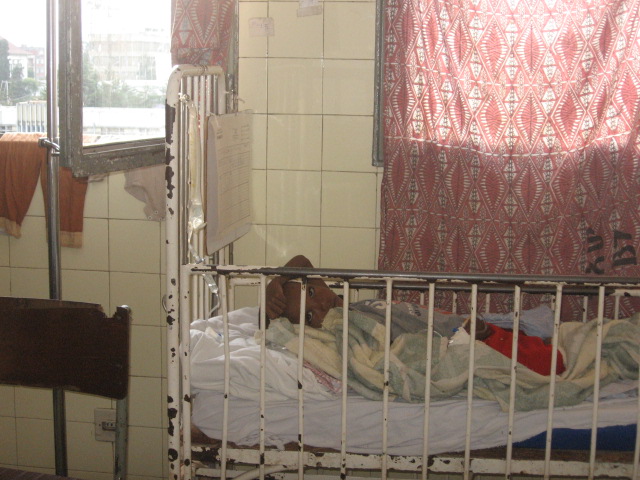
“There are things which much cause you to lose your reason, or you have none to lose”
I recently visited the pediatric casualty ward of Black Lion Hospital. The images I encountered there will remain with me forever.
Despite being one of the largest hospitals in the country, conditions are absolutely horrifying; the peeling white and yellow paint provides little contrast from the grey and dirty concrete floors and corridors marked by puddles of urine, vomit and other unidentifiable fluids. There are no fans in sight, and the foul stench of body odor, urine and disease is staggering. Though there seemed a minimum of 14 to a room, I saw no curtains or masks to divide those with malaria, HIV or dysentry from those with acute respiratory infections or other contagious diseases.
Where there are cribs they are, for the most part, in varying stages of unacceptable disrepair—the matresses are stained and torn and the rusted rails most often no longer close. The rest of the infants and young children are forced to lie wherever there is room (most without blankets) on dirty wooden benches or on the floor on makeshift cardboard mats. I saw three infants lying perilously on a surface resembling the stainless steel trays used in the West for holding the sterile equipment of surgeons. Family members who are unable to afford accomadation within the city have no choice but to sleep on the floor beneath or beside their dying young. The presence of doctors, nurses and interns are scarce—one anxious father reported that he had not seen his child’s doctor in over seven days. A mother begged me for water to give to her dying child, as another struggled desperately to give her newborn child medicine from a glass, due to the apparent absence of baby bottles or eye droppers in the ward. I saw a ‘cast’ made of duct tape, cardboard and a plastic bag worn by a tiny patient who lay wimpering on the floor with an IV attached to his head. I was told that in this hospital, infants suffering from a specific liver condition are placed directly underneath 100-watt bulbs, apparently for some kind of improvised treatment—an incredibly painful and dangerous procedure which on its own can cause blindness and severe burns.
Before leaving, I spoke briefly with a foreign intern who explained with a defeated sigh that every day they were forced to carry out medical procedures for which they were unqualified, because "there is simply nowhere to turn for help”.
Hope seemed, for the most part, absent from this ward; I was told most children would not live to see e following week.
(Annual Federal Health Expenditure: 4.9%)
Wednesday, January 31
Military Rule?

Today Addis truly reflects the virtual police state in which we live. Over the past week thousands of federal policemen have descended upon the city for the AU summit and, while this may help to ease the fears of the most corrupt African leaders visiting from abroad, residents here feel anything but safe. I have never seen the city like this—a comparable number of forces were deployed during Meskel (but concentrated entirely around the Square), but the atmosphere now feels even more oppressive due to their overwhelming omnipresence.
Under the watch of conspicuous rooftop snipers, federal and military wagons currently rule the roads, spilling out dozens upon dozens of blue-clad, heavily armed soldiers at a moment’s notice. These policemen are literally EVERYWHERE, waiting with guns cocked outside retaurants and cafes, schools and churches, in abandoned lots and on crowded corners, both on the main streets and side roads.
The rules of the city have also changed. At any given time, the roads suddenly close to allow for the procession of passing dignitaries—-walking on certain sides of the road becomes instantly prohibited and it is also forbidden to cross except at designated crosswalks. Now, anyone who has ever visited this city knows that traffic here is chaotic at best and, though there are no signs or roped off areas to signal any of this, residents here are somehow expected to anticipate these new rules—evidenced by soldiers who angrily shout incoherent demands, gesture threateningly with their machine guns or the backs of their hands, and chase down those who forgot to comply. The line between security and military rule appears increasingly blurred as the week progresses; though I am not aware that a city-wide curfew has been imposed, a friend and I were followed almost to our doorsteps the other night by a federal vehicle…apparently walking a couple of blocks after midnight is now considered a ‘suspicious activity’.
A couple of days ago one policeman boasted of the ‘excellent’ training that he had received from the Americans in “fighting the terrorists”. Figures. (Considering the quiet, local terror instilled by the blank, dehumanizing stares and gleaming AK-47s of these federal troops, I suppose the irony of this statement is almost humorous…) I guess it really shouldn’t matter much that the oppression here has now become equally visibly represented, but somehow it does...
Wednesday, January 17
Police Violence in the Streets
Yesterday while coming home from work I passed a group of policemen standing in a semi-circle. Though they were dressed in the tan uniforms of the local police, it was obvious by their guns and boots that they were actually federal security forces.
In the middle was a man who looked to be in his late-twenties, on his knees with his arms tied behind his back. His nose was bleeding and it was obvious that he had been beaten.
There must have been at least 6 or 7 of them. Before the traffic started up again, I saw the man look around in confusion and then flop over in the dirt on his side while the policeman moved closer--to close the cirlce, and, I assume, to block such crimes from the view of passing cars. Then they started kicking him.
This is Addis now.
In the middle was a man who looked to be in his late-twenties, on his knees with his arms tied behind his back. His nose was bleeding and it was obvious that he had been beaten.
There must have been at least 6 or 7 of them. Before the traffic started up again, I saw the man look around in confusion and then flop over in the dirt on his side while the policeman moved closer--to close the cirlce, and, I assume, to block such crimes from the view of passing cars. Then they started kicking him.
This is Addis now.
Monday, January 15
This Grand Potemkin Village
“Once upon a time, there was a man called Potemkin who was minister to the empress of the land. Hoping to earn her favor, he launched a military campaign and conquered new lands to add to her vast kingdom. Though the land itself was of little economic value, he told her of its greatness and was, in turn, rewarded.
One day the queen decided that, like any good monarch, it was her duty to visit her newly acquired territories and discover their potential. This posed a serious problem for Potemkin who had greatly exaggerated their worth. So he thought and he thought. “It is not possible to tell the queen that I have deceived her, “ he mused, “she will certainly be most angry with me.” So he thought and he thought some more. “Aha!” he exclaimed after some time. “I will disguise the poverty of the land and make it appear as if there is some development here!”
But the task of concealing the desolation of the vast and rural countryside was not a simple one, and her aides worked tirelessly day and night to ensure that all was hidden from view of the passing royal procession. Since they did not have enough time to satisfactorily increase the quality of life for the oppressed subjects of the kingdom, elaborate ‘false fronts’ were instead constructed to conceal the utter lack of regional development. Villagers from across the land were conscripted to help conceal the lack of infrastructure and ramshackle-poverty that would most certainly offend the queen, and no expense was spared--beautiful one-dimensional representations of the towns-that-should-have-been soon stretched for miles.
By the time the queen set off on her journey, the nation had been transformed, or at least it appeared so to the passing royal carriage. Though her aides were terrified that the villagers might forget to smile and wave at the temperamental monarch or, worse, that a mighty wind would come and knock over their massive wooden facade, everything went according to plan. The queen returned back to her palace under the assumption that all was fair throughout the land, and the aides lived happily ever after, (or at least they were allowed to live!), all thanks to the clever plan of a man called Potemkin. The end.”
Okay,…so maybe that wasn’t quite how it went down in 18th-century Russia. (he was, interestingly, her former lover and historians today more or less agree that the claims of ‘sham villages’ were probably greatly exaggerated), but whether fact or fiction, the legend has nonetheless since been internationally circulated and the practice of development for the sole purpose of deception has been adopted and implemented in all corners of the Earth.
I was reminded of this tale while recently touring the city with an aid worker new to the city. “My, my,” she exclaimed, “there certainly seems to be a lot of development going on in this city. At least this government is doing something right!”
Though we all know better, it is actually entirely understandable that she would arrive at this conclusion after spending only a few days in Addis:
The main road from the airport, for example, is littered with half-constructed buildings of all shapes and sizes which suggest ‘urban transformation and development’ in no uncertain terms to the weary traveller. Upon immediately entering the city (provided you stick to the main road, of course) such development even borders on indecent, as precarious wooden scaffolding rising in deliberate distraction from all directions; should you decide to visit “Old Airport” (home of the international embassies) , “Piasa” (city center) or “Bole” (especially near the shiny new World Bank building), you may even feel downright intimidated in the shadows of the towering business complexes and “nearly-completed” high rise (low-cost!) apartment buildings built obscenely close to the road, shamelessly flaunting their concrete wares for all to see. The fact that so many buildings are being so hurriedly erected literally on the side of of the road (without even room for a sidewalk in some places) seems more than a little suspicious (and easily suggests that, perhaps, there is much to hide) but given the dismal state of the national economy and blatantly declining of social conditions, such in-your-face development thankfully provides a much needed ‘escape clause’ for overwhelmed tourists, comfortable aid workers and placated politicians.
So, who is responsible for this wonderfully reasuring proliferation of concrete?
Well, they can definitely be attributed to foreign “assistance”, though not necessarily in the charitable fashion we prefer to assume. Some buildings are undoubtedly the labors of determined NGOs that have untangled themselves from the red-tape of the national civil service long enough to partially construct some buildings, and a precious few actually do belong to non-partisan private investors, I am told. However, a far greater number of the sites can be credited to the (apparently internationally intriguing) government contracts freely awarded to the low-bidding Chinese, and the obvious efforts of the Sheik to leave his scent all over the city.…which leaves the remainder of the contracts to be greedily divied up between the gaggle of homegrown nouveau-riche, EPRDF-supporting “businessmen”.
For all intensive political purposes, it seems the “act” of construction has now become favored over any potential end result within this city. And no wonder, considering the amount of aid dollars that continue to miraculously disappear within these borders every year! Fortunately, most diplomats, international donor assessment teams and self-assured foreign economists don’t actually spend enough time in the city to notice the chronic stagnance of the majority of the sites (though, admittedly, in some areas of the city buildings seem to pop up faster than you can say “vote harvesting”!) While it cannot be denied that most governments of the world have been found guilty of awarding contracts or lucrative ‘business opportunities’ to family, friends, and/or political supporters at some time or another, Ethiopian Prime Minister Meles Zenawi seems once again determined to lead the perverted pack of power-hungry politicians (say that 10 times fast! …Sorry, late-night buna kicking in) in the quest for bonded political validation.
At this time, such action serves two very important functions in this country:
1. To supply a shameless masquerade of “well-managed donor funds” (that can be referenced in a pinch to satisfy the international community) and
2. To ensure political loyalty amidst an increasingly vocal national majority opposition (umm…I hear they call it blackmail in the free world?)
It is common knowledge here in Addis that local construction contracts are almost exclusively distributed amongst party members and EPRDF “supporters” with breath-taking generosity and alarmingly low criteria, but just like everything else in this country, the evidence of such favoritism is obviously “everywhere and nowhere” and therefore easily ignored by the outside world.
This would, perhaps, be easier to understand if this new wave of development served to improve the lives of those living here, but so far the economy has failed to noticeably repsond. Though the investments of Al-Amoudi have naturally proven profitable for himself and the party members involved, they do not, for the most part, serve to significantly benefit the local community. He has obviously set his sights on visitors from abroad, and many of his ‘attractions’ (such as the Sheraton and the park) remain almost entirely inaccessible to Ethiopians for various reasons (cost and his ego, respectively). Those that remain affordable are intentionally boycotted by most citizens and therefore can no longer be considered a valuable economic contribution—Pepsi sales, for example are at an all time low. The system of consistently awarding major development contracts to the lowest bidder also raises some obvious questions: though I far prefer the self-interested development of the Chinese to the diastrous, multi-faceted consequences of guilt-driven Western charity, let’s face it--their roads are crap!
More importantly, the shameful state of the national economy, despite drastic increase in urban business ventures, can inarguably be attributed to the lack of capacity and requisite expertise and experience harnessed by the ruling minority party (which I plan to write much, much more about this at a later date). You see, apparently after being given a business liscence and development contract, you are actually supposed to have a viable business plan and even (*gasp!) efficiently operate for profit…which evidently poses quite a problem for many of the EPRDF’s business elite. A friend of mine in the construction business recently shared some hilarious stories of party members trying to get started (like the man who walked smugly into the office of an established civil engineer and told him that he needed a building designed immediately. Despite the fact that the confused cadre obviously required the services of an architect not an engineer, the man nonetheless played along. “Ok. What kind of building did you have in mind, sir” he asked, most likely stifling a laugh. “Uhh…you know,” the EPRDF stooge replied, “just a building. For rent.” “Just a building?” pressed the engineer. “I think you need to have something a little more…specific…in mind. Let’s try it this way—how large of a structure are you thinking?” “Big,” replied the cadre confidently. “I need one big building.” )
Though I am obviously paraphrasing, this pathetic exchange and countless others like it take place in this city on a regular basis, and the long-term consequences of such unskilled and corrupt transactions unfortunately extend far beyond the temporary appeasement of the international donor community. These unsuccessful businesses, in addition to failing to stimulate the economy, serve to absorb the finite land available for actual future city development and sap the nation’s resources with little or no return. Furthermore, shoddy, hastily-constructed buildings which fail to comply with minimal safety regulations are consistently approved for operations, creating hazardous environments for both construction workers and future employees, tennants and clients.
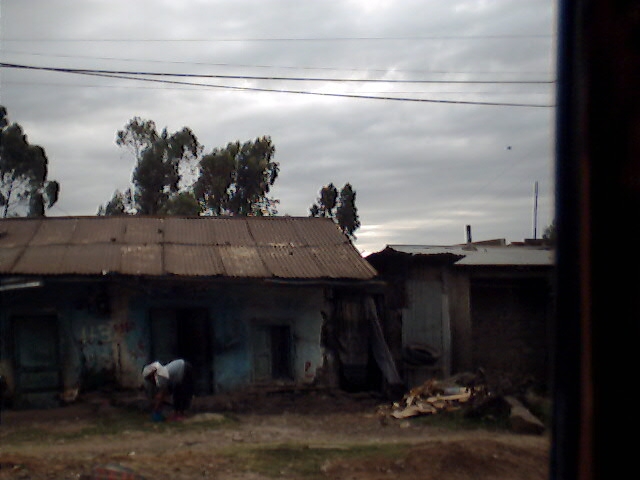
The essential government monopoly on urban development has also resulted in a notable absence of city planning. Though it seems a bit superfluous to mention, in Piasa (possibly the city’s only district which hints at architectural cohesion) the ghastly new high-rise buildings currently being constructed directly in the middle of the city square, couldn’t possibly appear more incongruent. On a more practical note, however, such a lack of central planning and long-term vision is beginning to create serious problems for a city already unable to cope with the ever-increasing number of rural-urban migrants. Instead of confronting this obviously critical issue, the city’s poor now find themselves even more tightly packed between the ‘false fronts’ of the main roads, forced further back into dangerously overcrowded slums by the large new buildings. In this way, it has become possible to hide most of the shocking urban poverty here, while at the same time giving the appearance of development—I am ashamed to admit that I stayed here for some time before discovering that over 90% of the houses in Addis are, in fact, constructed from corrugated tin and mud. The conditions of these proliferating slums are terrible and further deteriorating—there are few chimneys to relase the dangerous fumes from indoor cooking (most commonly fueled by cow dung, despite availability of alternate energy sources, due to the now impossibly inflated cost of charcoal), roofs leak, rats reign and disease runs rampant. Clean water is often not an option and sanitary conditions are unacceptable; hyenas scavenge the waste left out in the city by night, and during the day raw sewage flows through the gutters where children play.
I cannot figure out why no one cares or even appears to notice this, but I suppose we can again assume that Meles has once again fooled those who ‘matter’. Such conditions “are to be expected within the least-developed nations of the world”, I am repeatedly assured, and conversations always seem instead to focus on the city’s “positive new developments” (which ‘thankfully’ conceal such filth and poverty). It is truly unbelievable what the “razzle-dazzle” of some charasmatic double-speak, an array of deliberately obtrusive buildings and a whole lot of scaffolding can obscure.
Sunday, January 7
Fanning the Flames of Religious Conflict

Well, well,…It seems that Prime Minister Meles will once again ‘allow’ Orthodox Christians to call out to God for help!
Following the protests and mass arrests of November 2005--the recitation of Mehila (a collective prayer which resembles the pessmistic lyrics of Gregorian chant) was outlawed at several parishes throughout the city. (This ancient call-and-response prayer--translated in part as “Save us, Christ! In the name of the Virgin Mary, save us!”--is recognized as a desperate plea for the mercy of God, and has been practiced within the church for centuries.) After being outlawed for months without explanation, it was recently announced that local Christians are now permitted to resume practice of this prayer--a declaration that nicely coincided with the Prime Minister’s increasingly public intentions to drag this nation into war some weeks ago.
Though, in my opinion, few refrains could be considered more appropriate during this time, the phrase “too little, too late” also seems unfortunately well-suited, and this concession is duly recognized as yet another government attempt to ignite the passions of religious fundamentalists and further fragment this already divided society.
Some here and abroad seem comfortable defining the Somalian invasion as a primarily religious struggle (an admittedly romantic notion in an age where ethics and ancient doctrines are increasingly at odds with popular culture); however now, more than ever, it is important to accurately examine the history of this country before giving in to such seductions.
As one of the oldest Christian nations in the world, the traditions, practices and ideology of Orthodox Christianity have permeated every level of Ethiopian society, and continue to fashion much of the intellectual patterns and cultural values of this country today. Introduced in the 4th century A.D.(by Syrian monks who washed upon the shores of the Red Sea Coast following a shipwreck en route to India), Orthodox Christianity quickly expanded into all regions of the country, where it remains strictly practiced by tens of millions of Ethiopians today.
Though despite this rich Christian heritage, it is inaccurate to continully refer to modern Ethiopia as a Christian nation (granted it may be quite helpful in coaxing the support of zealous Western allies!). According to widely available national statistics, Ethiopian religious allegience is, in fact, divided roughly in half between Christianity and Islam (many sources even cite the population as primarily Muslim), which leaves approximately 35-40+ million followers of Islam peacefully residing within this “Christian nation”.
Though much of the Western world would have us believe otherwise, this fact alone is certainly no cause for alarm. Ethiopia has long-occupied the historical stance of religious tolerance, evidenced by the very manner in which Islam was first introduced into this country: In approximately 615 A.D., a group of Muslims were advised by the Prophet Muhammad to escape persecution in Mecca and seek refuge in Ethiopia (also the birthplace of Bilal, one of the Prophet’s closest companions). Upon arrival, they were warmly received by the Axumite king who provided asylum, and the teachings of the Prophet were subsequently spread throughout the land. This country has since held a position of honor among the Muslim world, internationally revered as the “Haven of the First Migration”(or Hijra) and eternal gratitude is expressed in the hadith—“Utruk Al-Habesha ma tarkukum” (“Leave the Abyssinians alone, so long as they do not take the offensive”). Tradionally, Muslim priests teach holding a sword, representative of the bloody, religious battles fought in the Arab world; in Ethiopia, however, a staff is instead carried as reminder of the peaceful circumstances in which the religion first reached Ethiopian soil.
Clashes between the followers of these two religions have since occurred intermittantly, without doubt (namely the violent uprisings of the 16th century), but Ethiopia has so far managed to avoid the brutal religious warfare that has marred the pasts of so many other nations, and continues to stand as a rare global testament to religious tolerance and cooperation.
While there are those who wish to involve Ethiopian Islam in the current global trend of ‘Islamic villification’, it seems quite ridiculous to assume that Ethiopian Muslims who have peacefully co-existed in this country for thousands of years will be suddenly inspired by foreign jihadists to take up arms against their brothers and sisters. That being said, it remains a fact that Ethiopia has witnessed an alarming increase in violent religious clashes over the past year, and current tensions between the two groups have reached unprecedented levels. But if it is not the ‘poisonous doctrines of neighboring extremists’ seeping across the borders, who then is responsible for this escalating internal conflict?
For those familiar with Ethiopian politics, such a question is, no doubt, rhetorical; once again, in-country evidence clearly fingers none other than the usual suspects—Meles Zenawi and his powerful entourage of international allies. Judging by the current social climate here, it appears the most serious threat to the precious remaining shreds of religious equilibrium can be found entirely within Ethiopia’s own borders, expertly moulded to assume a lethally complex 3-pronged front--stemming from religious, ethnic and political divide.
It is clear that religious conflict in this country has only recently adopted strong ethnic and political lines (which must be thoroughly examined in far greater detail than I can hope to provide). These factors were first conspicuously introduced into the religious debate during the 2005 election campaign, throughout which the EPRDF employed political discourse to paint the opposition CUD as a primarily anti-Muslim group (a subtle, but crucial distinction from portrayal as a primarily Christian party) attempting to usurp power in order to advance the interests of the Christian Amharas and restore Ethiopia to its original position as a predominantly Orthodox nation. In some regions this was intentionally very seriously propagated by the government, and this image has tragically served to bring about uneccessary lasting religious and ethnic disharmony (In Jimma, for example, the clashes occurred primarily between Muslim Oromos and Christian Amharas, designating the few Christian Oromos involved the “shameful stooges” of the Christian Amharas).
Though the EPRDF certainly had no intentions of establishing themselves as a ‘Muslim party’, they shamefully used the election opportunity to gain Muslim political support (particularly at the local level) by pitting them in this fashion against the official opposition, and thus, more dangerously, against specific ethnic groups as well as the nation’s vast Christian population.
In a climate where mistrust is actively encouraged by the government, conditions for violent conflict are naturally ripe—communities are divided, suspicions nursed, old grievances resurrected, and retaliation invited. It is, however, the lack of official action in response to these (arguably) inevitable religious clashes that has now become an increasingly serious cause for concern; according to sources, evidence surrounding some of the most recent and bloody religious conflicts, in fact, seems alarmingly suggestive of deliberate government instigation!
Again, in the instance of Jimma, during the clashes a few months ago in which at least 18 people were murdered (according to official reports, though eye-witnesses insist the toll is far higher), it has been revealed that the local administration repeatedly and deliberately ignored reports of imminent clash between the two religious groups. Such glaring ommission is nothing less than criminal, as it is the appointed responsibility of the government to swiftly act on such information and prevent certain bloodshed. (It is important to note that the people who finally intervened in this case--stopping the clashes and exposing the criminals—were, in fact, Muslims, not Christians. It was later also concluded that the the crimes were committed by a small, radical band of men, though the overwhelming majority of the Mulsim population condemned the attacks.) In similar outbreaks that have occurred in Gondor, Dilla and Jijigga over the past year, it has also been discovered that the violence was actually initially perpetrated by those who were leaders in their communities (of varying degree). It then stands to reason that without EPRDF consent these dangerous criminals would never have been appointed to community leadership positions (which naturally require close cooperation with the central government) and these clashes can then, in such light, be considered to have been instigated (both directly and indirecttly) by government action; or, at the very least, such evidence makes the party guilty by association.
The growing religious divide in this country is unfortunately even more complex. The tragic circumstances mentioned above can similarly be traced to an increasing lack of social cohesion due to the absence of national moral authority. The head of the Ethiopian Orthodox Church, Patriarch Abuna Paulos, has been considered to lack legitimacy from the very outset--after his election to the church’s highest and most sacred position through a process which was dubious at best. (Church law states that that a patriarch can only be replaced if found to be in violation of the basic doctrines of the church or if proven incapable of executing his repsonsibilities--in which case he traditionally almost always remains in power, relying more heavily on the assistance of aides). Though ‘health failure’ was publicly announced by the former patriarch Abuna Merkoriyos, upon relocation to the US, he revealed that he had actually been forced to resign by former Prime Minister Tamrat Layne, or face death. Many prominent scholars left the church immediately following this controversial election and the leadership of the church has since been viewed as largely corrupt and shamefully politically aligned. The head of the national Islamic Court was also appointed around the same time through a similarly questionable procedure, which has likewise served to strip him of true religious legitimacy. (It is worth recalling that during last year’s election campaign, religious leaders from both factions frequently appeared in the media in support of EPRDF platforms and policies, and both leaders publicly (albeit indirectly) denounced the official opposition on several occasions. Interestingly enough, just before the May 2005 elections, a meeting was held by the Prime Minister in his office, which required the attendance of all national religious leaders. During this session, both political and religious absurdities of all sorts abounded: one prominent Orthodox leader reportedly spoke at length on the “appropriateness of the national land policy”, while another announced that it was revealed to him through a vision that Meles was, in fact, the savior long prophesied (by Ethiopian legend, which suggests that a man called Tewodros will arise and come to save the nation from disaster). With similar flair, a high-ranking Muslim leader stood up and heatedly announced that they were ready to die to defend their rights from the “growing anti-Muslim population”…What a show it must have been!)
Such lack of moral authority evidently seems to have resulted in the further disintegration of social fabric, as communities now find themselves increasingly fragmented by the void of credible religious leadership exposed by last year’s election procedures. With such a largely dissatisfied population now unable to rely on either political or religious leaders to guide community decisions or dissolve regional tensions, the explosion of wide-scale domestic conflict now seems, sadly, only a matter of time.
Additionally, we can now thank Prime Minister Meles for further fueling this already precarious trend of religious unrest, by publicly polarizing the Ethiopian Muslim-Christian divide through his recent invasion of Somalia. Many Muslims feel betrayed by a government eager to label followers of Islam “radical, Taliban-loving extremists” (in a thinly-veiled effort to rejuvenate waning Western favor), and insulted by the insinuation that they could be so easily coerced into acts of terrorism by infiltrating Somali jihadists. The Christians, for their part, have also become increasingly unsettled—while most seem to recognize Meles’ exaggerated warnings of imminent attack for exactly what they are, furious few nonetheless now stand ready to defend their country from Muslim takeover “by any means necessary”. Add to that the mounting anger of both groups over the extreme ‘preventative’ measures recently taken by the federal government (last week’s wave of mass arrests)—and it seems that Meles just might have found the final ingredient in his recipe for disaster.
Or, perhaps the war was merely the final attempt by a government ‘in the hot seat’ to externalize the obvious national problems and divert attention and resources (both national and international)—hoping in vain to unite ‘all concerned’ against a common enemy?
Either way, the recent invasion has only served to aggravate an already dangerously explosive situation—both abroad and at home. It seems that now, as a direct result of the war, (not to be confused with the prior unfounded claims used to justify the invasion) there is suddenly a very real danger that this brewing dissent could be effectively cultivated and exploited by foreign fighters eager to wage holy war in this new sub-Saharan front. Now, the possibility that outside terrorist forces will seek to fund, arm, unite and provoke the small scattered bands of radical Islamists that do (without doubt) already exist in this country, must be seriously considered. With Somalia struggling to close its borders to the recent influx of thousands of foreign fighters and constant reports of ‘terrorists on the run’, it seems highly possible that determined jihadists could instead be re-routed to Ethiopia to carry out attacks on the capital from within. Such acts of terrorism would undoubtedly serve to convict the entire Ethiopian Muslim population (in the eyes of many here and within the international community) and could forseeably provoke immediate violent retaliation and eventual full-scale religious warfare.
Given the current lack of legitimate moral and political authority, combined with the simmering anger of the oppressed millions, the escalating tension in this country simply cannot be dismissed along with yesterday’s headlines. Whether the war has officially ended or not is longer the issue; rather, it appears we must immediately concern ourselves with how to avert the eruption of wide-scale religious conflict here. Such a volatile climate will certainly result in catastrophe if this growing social divide is not soon be mended, which naturally raises a most important question: Who here is suited for such a task?
Certainly not the current national leaders of either the Orthodox Church or the Islamic Court, who long ago publicly swapped allegiance from the moral to the political.
Certainly not the international community, who has eagerly embraced Ethiopia as the newest gladiator in the global anti-terrorist arena and ignorantly applauded her latest efforts at “regional stabilization”.
Most certainly NOT the dictatorial federal government, as has been repeatedly evidenced by their disgusting political corruption and horrific internal abuses.
So where then does that leave us?
Ethiopian salvation can clearly only be sought within the democratic process itself (which demands the release of all current political prisoners)– in a society where people are free to share their views and express dissent, and have confidence in the decisions and interventions of their elected leaders. Only then, through the functions of a healthy democracy (based on the fair representation of citizens and their concerns and equitable distribution of resources) will there be any hope of bridging this widening divide and restoring this fragmented nation.
Following the protests and mass arrests of November 2005--the recitation of Mehila (a collective prayer which resembles the pessmistic lyrics of Gregorian chant) was outlawed at several parishes throughout the city. (This ancient call-and-response prayer--translated in part as “Save us, Christ! In the name of the Virgin Mary, save us!”--is recognized as a desperate plea for the mercy of God, and has been practiced within the church for centuries.) After being outlawed for months without explanation, it was recently announced that local Christians are now permitted to resume practice of this prayer--a declaration that nicely coincided with the Prime Minister’s increasingly public intentions to drag this nation into war some weeks ago.
Though, in my opinion, few refrains could be considered more appropriate during this time, the phrase “too little, too late” also seems unfortunately well-suited, and this concession is duly recognized as yet another government attempt to ignite the passions of religious fundamentalists and further fragment this already divided society.
Some here and abroad seem comfortable defining the Somalian invasion as a primarily religious struggle (an admittedly romantic notion in an age where ethics and ancient doctrines are increasingly at odds with popular culture); however now, more than ever, it is important to accurately examine the history of this country before giving in to such seductions.
As one of the oldest Christian nations in the world, the traditions, practices and ideology of Orthodox Christianity have permeated every level of Ethiopian society, and continue to fashion much of the intellectual patterns and cultural values of this country today. Introduced in the 4th century A.D.(by Syrian monks who washed upon the shores of the Red Sea Coast following a shipwreck en route to India), Orthodox Christianity quickly expanded into all regions of the country, where it remains strictly practiced by tens of millions of Ethiopians today.
Though despite this rich Christian heritage, it is inaccurate to continully refer to modern Ethiopia as a Christian nation (granted it may be quite helpful in coaxing the support of zealous Western allies!). According to widely available national statistics, Ethiopian religious allegience is, in fact, divided roughly in half between Christianity and Islam (many sources even cite the population as primarily Muslim), which leaves approximately 35-40+ million followers of Islam peacefully residing within this “Christian nation”.
Though much of the Western world would have us believe otherwise, this fact alone is certainly no cause for alarm. Ethiopia has long-occupied the historical stance of religious tolerance, evidenced by the very manner in which Islam was first introduced into this country: In approximately 615 A.D., a group of Muslims were advised by the Prophet Muhammad to escape persecution in Mecca and seek refuge in Ethiopia (also the birthplace of Bilal, one of the Prophet’s closest companions). Upon arrival, they were warmly received by the Axumite king who provided asylum, and the teachings of the Prophet were subsequently spread throughout the land. This country has since held a position of honor among the Muslim world, internationally revered as the “Haven of the First Migration”(or Hijra) and eternal gratitude is expressed in the hadith—“Utruk Al-Habesha ma tarkukum” (“Leave the Abyssinians alone, so long as they do not take the offensive”). Tradionally, Muslim priests teach holding a sword, representative of the bloody, religious battles fought in the Arab world; in Ethiopia, however, a staff is instead carried as reminder of the peaceful circumstances in which the religion first reached Ethiopian soil.
Clashes between the followers of these two religions have since occurred intermittantly, without doubt (namely the violent uprisings of the 16th century), but Ethiopia has so far managed to avoid the brutal religious warfare that has marred the pasts of so many other nations, and continues to stand as a rare global testament to religious tolerance and cooperation.
While there are those who wish to involve Ethiopian Islam in the current global trend of ‘Islamic villification’, it seems quite ridiculous to assume that Ethiopian Muslims who have peacefully co-existed in this country for thousands of years will be suddenly inspired by foreign jihadists to take up arms against their brothers and sisters. That being said, it remains a fact that Ethiopia has witnessed an alarming increase in violent religious clashes over the past year, and current tensions between the two groups have reached unprecedented levels. But if it is not the ‘poisonous doctrines of neighboring extremists’ seeping across the borders, who then is responsible for this escalating internal conflict?
For those familiar with Ethiopian politics, such a question is, no doubt, rhetorical; once again, in-country evidence clearly fingers none other than the usual suspects—Meles Zenawi and his powerful entourage of international allies. Judging by the current social climate here, it appears the most serious threat to the precious remaining shreds of religious equilibrium can be found entirely within Ethiopia’s own borders, expertly moulded to assume a lethally complex 3-pronged front--stemming from religious, ethnic and political divide.
It is clear that religious conflict in this country has only recently adopted strong ethnic and political lines (which must be thoroughly examined in far greater detail than I can hope to provide). These factors were first conspicuously introduced into the religious debate during the 2005 election campaign, throughout which the EPRDF employed political discourse to paint the opposition CUD as a primarily anti-Muslim group (a subtle, but crucial distinction from portrayal as a primarily Christian party) attempting to usurp power in order to advance the interests of the Christian Amharas and restore Ethiopia to its original position as a predominantly Orthodox nation. In some regions this was intentionally very seriously propagated by the government, and this image has tragically served to bring about uneccessary lasting religious and ethnic disharmony (In Jimma, for example, the clashes occurred primarily between Muslim Oromos and Christian Amharas, designating the few Christian Oromos involved the “shameful stooges” of the Christian Amharas).
Though the EPRDF certainly had no intentions of establishing themselves as a ‘Muslim party’, they shamefully used the election opportunity to gain Muslim political support (particularly at the local level) by pitting them in this fashion against the official opposition, and thus, more dangerously, against specific ethnic groups as well as the nation’s vast Christian population.
In a climate where mistrust is actively encouraged by the government, conditions for violent conflict are naturally ripe—communities are divided, suspicions nursed, old grievances resurrected, and retaliation invited. It is, however, the lack of official action in response to these (arguably) inevitable religious clashes that has now become an increasingly serious cause for concern; according to sources, evidence surrounding some of the most recent and bloody religious conflicts, in fact, seems alarmingly suggestive of deliberate government instigation!
Again, in the instance of Jimma, during the clashes a few months ago in which at least 18 people were murdered (according to official reports, though eye-witnesses insist the toll is far higher), it has been revealed that the local administration repeatedly and deliberately ignored reports of imminent clash between the two religious groups. Such glaring ommission is nothing less than criminal, as it is the appointed responsibility of the government to swiftly act on such information and prevent certain bloodshed. (It is important to note that the people who finally intervened in this case--stopping the clashes and exposing the criminals—were, in fact, Muslims, not Christians. It was later also concluded that the the crimes were committed by a small, radical band of men, though the overwhelming majority of the Mulsim population condemned the attacks.) In similar outbreaks that have occurred in Gondor, Dilla and Jijigga over the past year, it has also been discovered that the violence was actually initially perpetrated by those who were leaders in their communities (of varying degree). It then stands to reason that without EPRDF consent these dangerous criminals would never have been appointed to community leadership positions (which naturally require close cooperation with the central government) and these clashes can then, in such light, be considered to have been instigated (both directly and indirecttly) by government action; or, at the very least, such evidence makes the party guilty by association.
The growing religious divide in this country is unfortunately even more complex. The tragic circumstances mentioned above can similarly be traced to an increasing lack of social cohesion due to the absence of national moral authority. The head of the Ethiopian Orthodox Church, Patriarch Abuna Paulos, has been considered to lack legitimacy from the very outset--after his election to the church’s highest and most sacred position through a process which was dubious at best. (Church law states that that a patriarch can only be replaced if found to be in violation of the basic doctrines of the church or if proven incapable of executing his repsonsibilities--in which case he traditionally almost always remains in power, relying more heavily on the assistance of aides). Though ‘health failure’ was publicly announced by the former patriarch Abuna Merkoriyos, upon relocation to the US, he revealed that he had actually been forced to resign by former Prime Minister Tamrat Layne, or face death. Many prominent scholars left the church immediately following this controversial election and the leadership of the church has since been viewed as largely corrupt and shamefully politically aligned. The head of the national Islamic Court was also appointed around the same time through a similarly questionable procedure, which has likewise served to strip him of true religious legitimacy. (It is worth recalling that during last year’s election campaign, religious leaders from both factions frequently appeared in the media in support of EPRDF platforms and policies, and both leaders publicly (albeit indirectly) denounced the official opposition on several occasions. Interestingly enough, just before the May 2005 elections, a meeting was held by the Prime Minister in his office, which required the attendance of all national religious leaders. During this session, both political and religious absurdities of all sorts abounded: one prominent Orthodox leader reportedly spoke at length on the “appropriateness of the national land policy”, while another announced that it was revealed to him through a vision that Meles was, in fact, the savior long prophesied (by Ethiopian legend, which suggests that a man called Tewodros will arise and come to save the nation from disaster). With similar flair, a high-ranking Muslim leader stood up and heatedly announced that they were ready to die to defend their rights from the “growing anti-Muslim population”…What a show it must have been!)
Such lack of moral authority evidently seems to have resulted in the further disintegration of social fabric, as communities now find themselves increasingly fragmented by the void of credible religious leadership exposed by last year’s election procedures. With such a largely dissatisfied population now unable to rely on either political or religious leaders to guide community decisions or dissolve regional tensions, the explosion of wide-scale domestic conflict now seems, sadly, only a matter of time.
Additionally, we can now thank Prime Minister Meles for further fueling this already precarious trend of religious unrest, by publicly polarizing the Ethiopian Muslim-Christian divide through his recent invasion of Somalia. Many Muslims feel betrayed by a government eager to label followers of Islam “radical, Taliban-loving extremists” (in a thinly-veiled effort to rejuvenate waning Western favor), and insulted by the insinuation that they could be so easily coerced into acts of terrorism by infiltrating Somali jihadists. The Christians, for their part, have also become increasingly unsettled—while most seem to recognize Meles’ exaggerated warnings of imminent attack for exactly what they are, furious few nonetheless now stand ready to defend their country from Muslim takeover “by any means necessary”. Add to that the mounting anger of both groups over the extreme ‘preventative’ measures recently taken by the federal government (last week’s wave of mass arrests)—and it seems that Meles just might have found the final ingredient in his recipe for disaster.
Or, perhaps the war was merely the final attempt by a government ‘in the hot seat’ to externalize the obvious national problems and divert attention and resources (both national and international)—hoping in vain to unite ‘all concerned’ against a common enemy?
Either way, the recent invasion has only served to aggravate an already dangerously explosive situation—both abroad and at home. It seems that now, as a direct result of the war, (not to be confused with the prior unfounded claims used to justify the invasion) there is suddenly a very real danger that this brewing dissent could be effectively cultivated and exploited by foreign fighters eager to wage holy war in this new sub-Saharan front. Now, the possibility that outside terrorist forces will seek to fund, arm, unite and provoke the small scattered bands of radical Islamists that do (without doubt) already exist in this country, must be seriously considered. With Somalia struggling to close its borders to the recent influx of thousands of foreign fighters and constant reports of ‘terrorists on the run’, it seems highly possible that determined jihadists could instead be re-routed to Ethiopia to carry out attacks on the capital from within. Such acts of terrorism would undoubtedly serve to convict the entire Ethiopian Muslim population (in the eyes of many here and within the international community) and could forseeably provoke immediate violent retaliation and eventual full-scale religious warfare.
Given the current lack of legitimate moral and political authority, combined with the simmering anger of the oppressed millions, the escalating tension in this country simply cannot be dismissed along with yesterday’s headlines. Whether the war has officially ended or not is longer the issue; rather, it appears we must immediately concern ourselves with how to avert the eruption of wide-scale religious conflict here. Such a volatile climate will certainly result in catastrophe if this growing social divide is not soon be mended, which naturally raises a most important question: Who here is suited for such a task?
Certainly not the current national leaders of either the Orthodox Church or the Islamic Court, who long ago publicly swapped allegiance from the moral to the political.
Certainly not the international community, who has eagerly embraced Ethiopia as the newest gladiator in the global anti-terrorist arena and ignorantly applauded her latest efforts at “regional stabilization”.
Most certainly NOT the dictatorial federal government, as has been repeatedly evidenced by their disgusting political corruption and horrific internal abuses.
So where then does that leave us?
Ethiopian salvation can clearly only be sought within the democratic process itself (which demands the release of all current political prisoners)– in a society where people are free to share their views and express dissent, and have confidence in the decisions and interventions of their elected leaders. Only then, through the functions of a healthy democracy (based on the fair representation of citizens and their concerns and equitable distribution of resources) will there be any hope of bridging this widening divide and restoring this fragmented nation.
Subscribe to:
Posts (Atom)
